From Medieval Fortress to Baroque Masterpiece
The history of Noto presents one of the most striking cases of urban discontinuity in Europe: a city that exists today not as an evolution of its past, but as a deliberate replacement for it. The modern city is the product of a late 17th-century relocation, undertaken after a catastrophic earthquake rendered its predecessor unviable. What emerged from this rupture was not merely a rebuilt town, but a carefully planned urban landscape that would become a defining example of Sicilian Late Baroque architecture.
The Foundations of Noto Antica
Before 1693, the city now known as Noto Antica stood roughly eight kilometers north of the present site, atop the limestone plateau of Monte Alveria. Its position was naturally fortified, surrounded by steep gorges that made it defensible and strategically significant.
Archaeological and historical evidence indicates continuous habitation from antiquity, with roots extending at least to the early first millennium BCE. Over successive periods of Greek, Roman, and Byzantine control, the settlement retained regional importance. Under Arab rule in the 9th century, it became the administrative center of the Val di Noto, one of Sicily’s principal districts—a role it maintained, in modified form, through subsequent Norman and Spanish governance.
By the late medieval period, Noto had developed into a dense, fortified citadel. Its urban fabric consisted of narrow, winding streets and tightly packed stone buildings, enclosed within defensive walls and dominated by a castle complex. By the 17th century, the city was a significant regional center, with a population estimated in the tens of thousands, numerous churches and monasteries, and an established aristocratic presence. Its architecture reflected both its military function and its long continuity as a seat of power.
The Seismic Catastrophe of 1693
This continuity was abruptly broken by the 1693 Sicily earthquake, one of the most powerful and destructive seismic events in Italian history. The disaster unfolded as a sequence: a strong foreshock on January 9 caused widespread damage, followed by the main earthquake on the evening of January 11, now estimated at magnitude 7.3–7.4.
The consequences were catastrophic across southeastern Sicily. In Noto Antica, the combination of heavy masonry construction and constricted streets amplified the destruction. Buildings collapsed into the narrow thoroughfares, leaving little room for escape. Key structures—including the cathedral and the castle—were destroyed or irreparably damaged. Casualty figures are uncertain, but contemporary reports suggest that a substantial portion of the population perished.
Beyond the immediate devastation, the site itself was left unstable and strategically compromised. While not entirely uninhabitable, the scale of destruction and the risks associated with rebuilding on the same terrain prompted serious reconsideration of the city’s future.
Relocation and Authority: The Duke of Camastra
In the aftermath, reconstruction efforts across the region were coordinated under the authority of Giuseppe Lanza, appointed by the Spanish administration as Vicar General for the affected territories. Rather than simply rebuilding destroyed towns in situ, the authorities in several cases—including Noto—opted for relocation.
After deliberation and local debate, a new site was selected on the slopes of Mount Meti. The move began in the 1690s, only a few years after the earthquake. The new location offered practical advantages: more accessible terrain, proximity to coastal routes, and abundant local limestone suitable for construction.
The decision was not without resistance, particularly from landowning elites tied to the old site. Nevertheless, relocation prevailed, marking a decisive break with the medieval city and creating the conditions for a fundamentally new urban form.
A Planned Rebirth
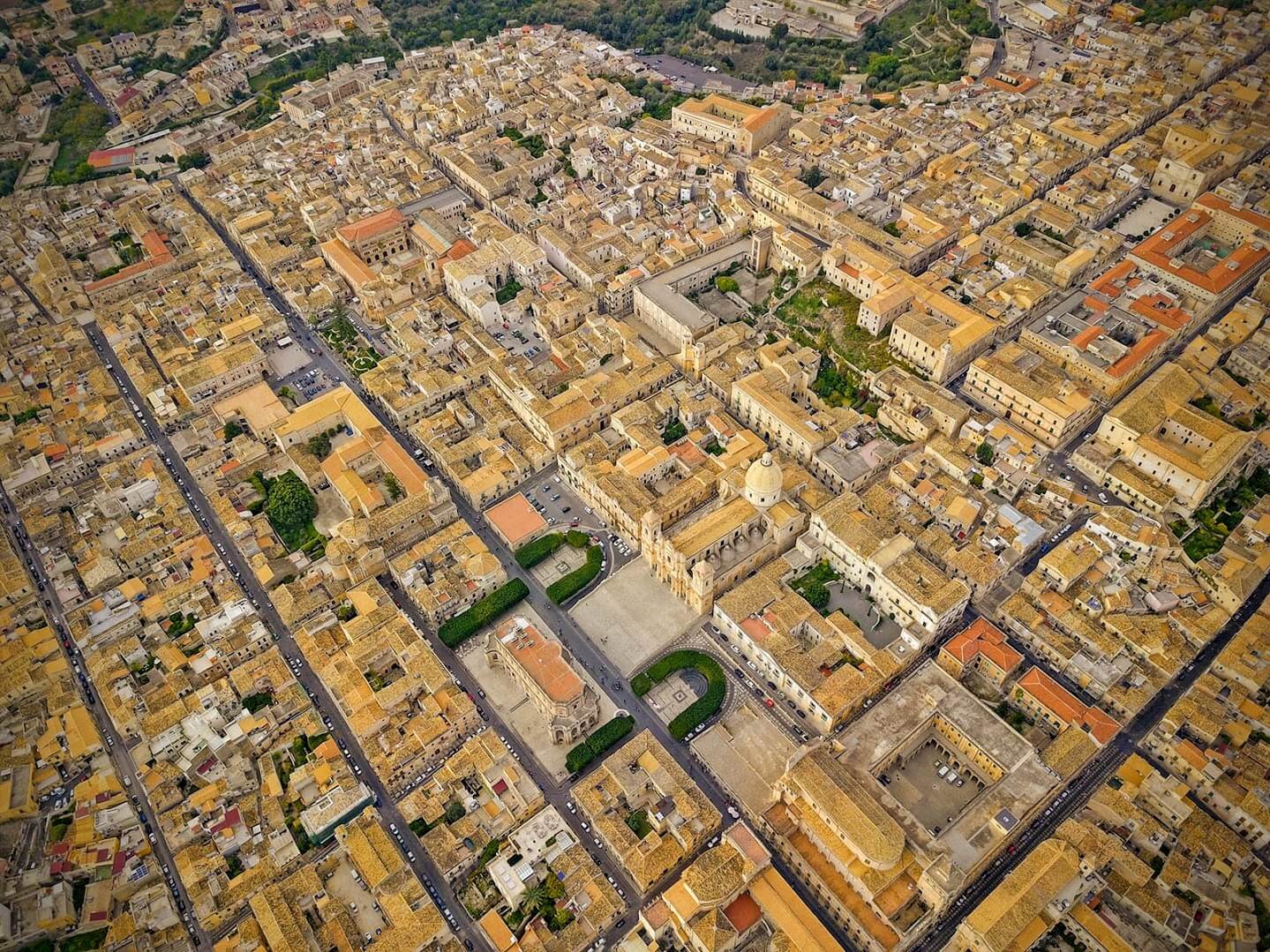
The new Noto was conceived according to principles that, while rooted in Baroque urbanism, also reflected a growing emphasis on order, accessibility, and risk mitigation. Rather than replicating the dense and irregular layout of the old city, planners adopted a more structured approach adapted to the natural slope of the terrain.
The urban layout developed along a series of broad, gently curving axes, most prominently the Corso Vittorio Emanuele, which organized the city from west to east. Wide streets and open piazzas were deliberately incorporated, not only for aesthetic effect but also to reduce the dangers associated with future earthquakes by providing open spaces and clearer routes of movement.
The city was arranged across three ascending terraces. While this created a visible stratification of space, the distribution of social and institutional functions followed established patterns: major churches, monasteries, and aristocratic residences occupied prominent and elevated positions, while commercial and civic life concentrated along the main thoroughfares.
No single architect can be credited with the overall plan. Instead, the city emerged through the coordinated work of administrators, engineers, and architects, including figures such as Angelo Italia, whose influence is sometimes noted, though not definitively documented.
The Architecture of a “Stone Garden”
The visual identity of the rebuilt city was shaped primarily by architects such as Rosario Gagliardi, Vincenzo Sinatra, and Paolo Labisi. Working within the Late Baroque style, they produced an urban ensemble characterized by dynamic façades, elaborate ornamentation, and a strong sense of theatricality.
The local limestone, relatively soft when quarried, allowed for intricate carving and detailed decorative work. Over time, exposure to sunlight gives the material its distinctive warm, golden tones, contributing to the city’s cohesive visual character.
Among the most prominent structures is the Noto Cathedral, positioned at the top of a monumental staircase and anchoring a central piazza. Other landmarks, such as the Church of San Domenico and Palazzo Ducezio, were carefully situated to take advantage of the المدينة’s topography, creating long perspectives and dramatic visual alignments.
Aristocratic palaces, including the Palazzo Nicolaci, feature richly decorated balconies supported by sculptural brackets depicting figures ranging from cherubs to fantastical creatures. These elements exemplify the expressive and ornamental qualities of Sicilian Baroque architecture.
Legacy and Recognition
The reconstruction of Noto unfolded over the course of the 18th century, resulting in an urban environment of remarkable coherence. Unlike cities that evolved gradually over centuries, Noto reflects a relatively concentrated phase of architectural and urban development, giving it an unusual degree of stylistic unity.
Today, the city forms part of the UNESCO-listed Late Baroque Towns of the Val di Noto, recognized for their outstanding representation of post-earthquake reconstruction and Baroque urban design. Within this group, Noto stands out as one of the most complete and harmonious examples—a city born from destruction, yet defined by deliberate design.