At first glance, Siracusa's historic island appears compact and almost modest. Connected to the mainland by only a short bridge, it occupies less than a square kilometre. Yet within this small space lies one of the oldest continuously inhabited urban centres in the Mediterranean. Greek settlers first established themselves here nearly 2,800 years ago, and every civilisation that followed left traces upon its narrow streets and elegant squares.
Ortigia is not a place to rush through with a checklist in hand. It is best experienced slowly. It rewards those who pause beneath weathered balconies, step inside quiet churches, linger over a coffee in sunlit piazzas, and allow themselves to wander down streets without knowing exactly where they lead.
Unlike the archaeological districts of mainland Siracusa, Ortigia feels deeply lived-in. Laundry still flutters between buildings. Elderly residents exchange greetings outside neighbourhood cafés. Children weave through alleyways that have existed since antiquity. Here, the island's remarkable history remains woven into everyday life.
Many of our guests at Casa Bandello arrive expecting Ortigia to be beautiful. They leave surprised by how personal it feels.
In this first part of our guide, we explore the monuments and spaces that shape a visitor's first impressions of Ortigia: from ancient Greek temples and bustling food markets to one of Italy's most extraordinary cathedral squares.
Reaching Ortigia from Noto
One of the reasons we frequently recommend Ortigia to our guests is its accessibility from Noto.
By car, the journey usually takes around 40 minutes via the A18/E45 motorway. Public parking is available near the entrance to Ortigia, although spaces fill quickly during weekends and throughout the summer months. We generally suggest arriving before mid-morning to avoid both traffic and the midday heat.
Regional trains from Noto to Siracusa take just over half an hour. From Siracusa railway station, Ortigia can be reached on foot in approximately twenty minutes, or in just a few minutes by taxi or local bus.
Interbus services also connect the two cities regularly throughout the day.
Once you arrive, Ortigia is wonderfully walkable. In fact, walking is the only way to truly appreciate the island's character. Distances are short, but the temptation to stop, observe, and explore means that even a small area can occupy an entire day.
1. Temple of Apollo
A Place That Shaped Ortigia
Standing near the northern entrance to Ortigia, the Temple of Apollo represents the beginning of the island's extraordinary story.
Constructed around the early sixth century BC, it is considered the oldest Doric temple in Sicily and among the earliest examples of monumental Greek architecture in the western Mediterranean. For the Corinthian settlers who arrived on Ortigia in 734 BC, building such a temple was both a religious act and a statement of permanence. It proclaimed that this newly founded colony intended not merely to survive, but to flourish.
Dedicated to Apollo, the Greek god associated with music, prophecy, healing, and light, the temple occupied a prominent position close to what would have been one of the island's principal access points. The choice of location was deliberate. Visitors arriving in ancient Siracusa would immediately encounter a monument that reflected the city's prosperity, ambition, and devotion.
Yet perhaps the most fascinating aspect of the Temple of Apollo lies in its continued reinvention.
Over nearly twenty-six centuries, the structure has served many purposes. During Byzantine times it became a Christian church. Under Arab rule, it was adapted into a mosque. During the Norman period, it returned once again to Christian use. Centuries later, portions of the site were incorporated into military barracks and private residences before archaeologists finally uncovered its ancient foundations in the late nineteenth and early twentieth centuries.
Few monuments encapsulate Sicily's layered history so completely. Rather than existing as a relic frozen in time, the Temple of Apollo tells a story of adaptation, resilience, and cultural transformation.
What You'll Discover Today
Visitors today encounter a striking collection of surviving columns and stone foundations rising unexpectedly from a busy urban setting.
The temple no longer possesses its complete grandeur, and perhaps that is precisely what makes it so compelling. Ancient limestone columns stand against a backdrop of passing scooters, apartment balconies, and everyday Sicilian life. Rather than being isolated behind barriers far removed from modern existence, the monument remains integrated into the living fabric of Ortigia.
It is impossible not to marvel at the engineering achievement represented by these remains. The massive stone blocks were quarried, transported, and assembled at a time when such undertakings required extraordinary organisation and labour.
Many guests are surprised by how emotional the experience can be. Knowing that these columns have witnessed Greek colonists, Roman administrators, Byzantine clergy, Arab merchants, Norman knights, and countless generations of local residents creates an almost overwhelming sense of continuity.
The temple also serves as an ideal introduction to Ortigia itself. Here, visitors begin to understand that the island cannot be reduced to a single historical identity. Every civilisation contributed another layer to the place we see today.
Our Tips for Visiting
The temple is best appreciated either early in the morning or in the late afternoon, when softer light enhances the warm tones of the limestone.
Spend a few moments walking around the perimeter to appreciate its relationship with the surrounding city.
Because there is no entrance fee or lengthy visit required, it makes a perfect starting point for exploring Ortigia.
Don't Miss
Crossing the bridge into Ortigia and seeing the Temple of Apollo emerge among modern buildings offers one of Sicily's most powerful visual reminders that ancient history and contemporary life coexist here every day.
2. Ortigia Market
A Place That Shaped Ortigia
To understand Ortigia fully, one must look beyond its monuments and pay attention to the rhythms of everyday life.
For centuries, markets have functioned as the social and economic heart of Mediterranean communities. Long before supermarkets and online shopping, local markets were places where relationships formed, news circulated, and traditions passed from one generation to the next.
Ortigia's market continues this legacy.
Located close to the Temple of Apollo, the market district developed naturally through the island's role as an important commercial centre. Merchants arriving by sea brought spices, preserved foods, textiles, and agricultural products from across the Mediterranean. Local fishermen supplied fresh catches from surrounding waters, while farmers from inland Sicily transported seasonal produce into the city.
Although modern tourism has introduced new influences, the market remains fundamentally rooted in local culture. It reflects the extraordinary richness of Sicilian cuisine itself—a culinary tradition shaped by Greek, Arab, Spanish, Norman, and Italian influences over centuries.
For visitors, the market provides an invaluable reminder that Ortigia is not merely an open-air museum. It is a place where people continue to cook, shop, argue, laugh, and maintain traditions deeply connected to the land and sea.
What You'll Discover Today
The Ortigia Market is a feast for the senses.
Colourful displays of tomatoes, aubergines, citrus fruits, pistachios, olives, herbs, and seasonal vegetables spill across counters beneath striped awnings. Fishmongers proudly present the morning's catch: swordfish, tuna, squid, prawns, and sea bream displayed with theatrical flair. The air carries aromas of fresh basil, cured meats, local cheeses, and occasionally the unmistakable scent of the sea.
Vendors enthusiastically call out greetings and recommendations. Even visitors who speak little Italian often find themselves drawn into conversations through gestures, smiles, and shared enthusiasm for good food.
Small eateries and delicatessens tucked among the stalls offer opportunities to sample Sicilian specialities prepared with remarkable freshness. A sandwich filled with local cheeses and cured meats, freshly fried seafood, or a simple plate of seasonal produce can become one of the highlights of the day.
Unlike carefully curated tourist attractions, the market feels spontaneous and authentic. It changes according to the seasons, weather conditions, and what fishermen happen to bring ashore.
Each visit is slightly different.
Our Tips for Visiting
Visit in the morning, ideally before lunchtime, when the market is at its liveliest.
Bring cash for smaller purchases and don't hesitate to ask vendors for recommendations.
If you're staying in self-catering accommodation, this is one of the best places in southeastern Sicily to purchase exceptional local ingredients.
Don't Miss
Take time to observe the interactions between vendors and local residents. These exchanges reveal far more about Sicilian culture than any guidebook ever could.
3. Via Cavour and Via Roma
A Place That Shaped Ortigia
Some of Ortigia's greatest pleasures cannot be found within churches or museums.
Via Cavour and Via Roma serve as the island's elegant arteries, connecting major landmarks while revealing the quieter beauty of everyday urban life. Over centuries, these streets evolved alongside changing political fortunes and architectural tastes, gradually becoming among Ortigia's most refined thoroughfares.
Following the devastating earthquake of 1693 that reshaped much of southeastern Sicily, reconstruction efforts introduced Baroque influences that continue to define the region's visual identity. Noble families invested in impressive residences featuring ornate balconies, decorative stonework, and grand entrances designed to communicate status and sophistication.
Yet these streets have always belonged to more than the aristocracy.
Artisans maintained workshops here. Merchants conducted business. Children played in nearby alleyways. Residents exchanged greetings from balconies overlooking the passing world below.
They remain spaces where the extraordinary and ordinary coexist effortlessly.
What You'll Discover Today
Walking along Via Cavour and Via Roma is one of the simplest yet most rewarding experiences in Ortigia.
Elegant façades line the streets, their honey-coloured limestone changing character as sunlight shifts throughout the day. Decorative balconies supported by carved masks and mythical creatures project above visitors' heads, inviting closer inspection.
Boutiques, artisan shops, bookstores, cafés, and gelaterias occupy historic buildings without overwhelming their architectural integrity. Side streets branch unexpectedly toward hidden courtyards and glimpses of the sea.
Many guests tell us these walks become among their favourite memories precisely because nothing dramatic happens. There are no queues, tickets, or prescribed routes. Instead, there is the pleasure of noticing details: an elaborately carved doorway, the scent of coffee drifting from a nearby café, the sound of footsteps echoing against ancient stone.
These are streets designed for wandering rather than rushing.
Our Tips for Visiting
Allow yourself to get slightly lost.
Early evening is particularly atmospheric as residents emerge for their traditional passeggiata.
Wear comfortable shoes, as the temptation to explore every side street is difficult to resist.
Don't Miss
Look upward. Some of Ortigia's most beautiful architectural details are found not at eye level but high above the street on ornate balconies and façades.
4. Piazza Duomo
A Place That Shaped Ortigia
There are beautiful squares throughout Italy.
Then there is Piazza Duomo.
Widely regarded as one of the most magnificent piazzas in the country, this remarkable space represents the culmination of centuries of artistic ambition, civic pride, and religious devotion.
Its current appearance owes much to the reconstruction efforts that followed the catastrophic earthquake of 1693. Architects transformed the square into an elegant Baroque stage set, carefully orchestrating the relationship between surrounding buildings to create harmony and theatrical grandeur.
Yet beneath this refined beauty lies a far older history.
The piazza occupies ground that formed the sacred heart of ancient Siracusa. Greek temples once dominated the site before successive civilisations reshaped the landscape according to their own values and aspirations.
As a result, Piazza Duomo embodies Ortigia's defining characteristic: continuity through transformation.
What You'll Discover Today
Many visitors describe entering Piazza Duomo as a moment of genuine astonishment.
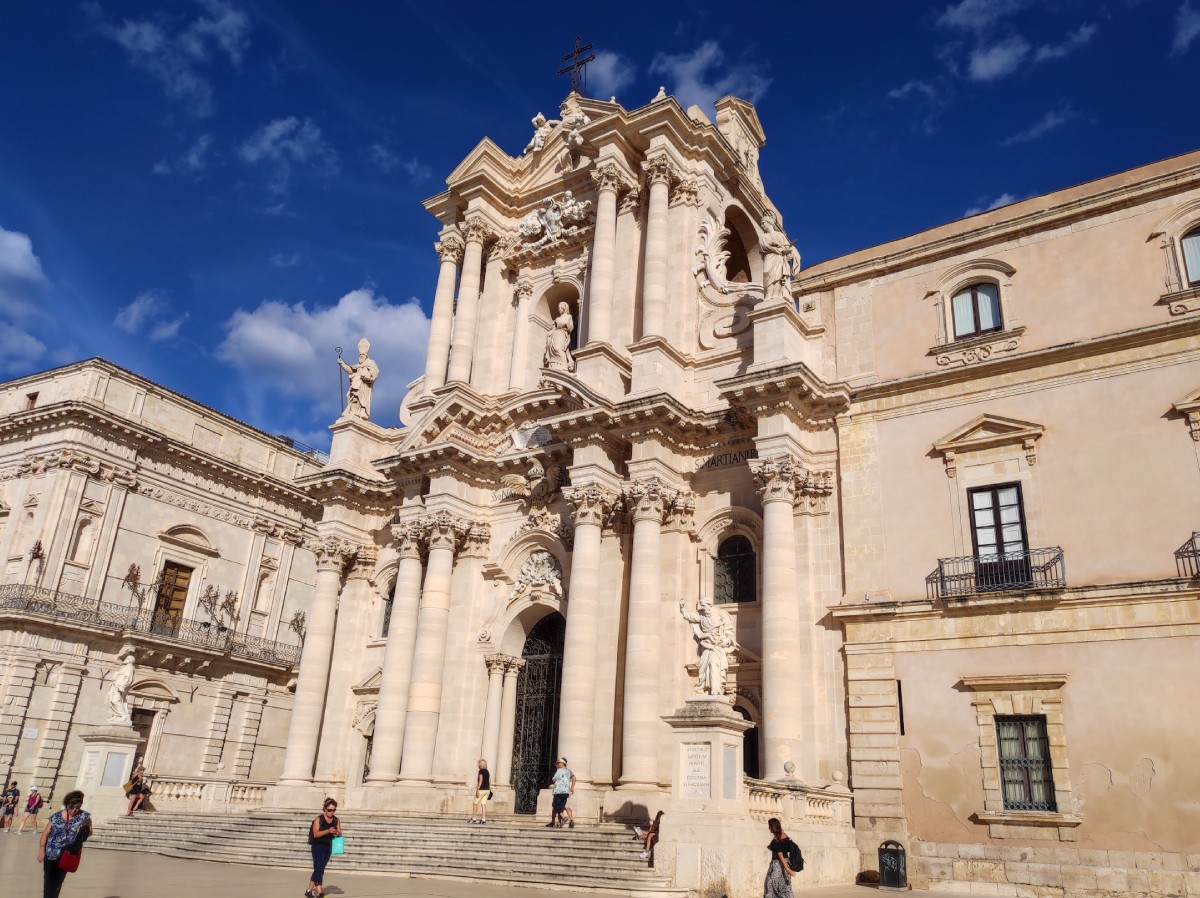
After navigating Ortigia's narrow streets, the sudden openness of the square feels dramatic. Honey-coloured limestone façades glow beneath the Sicilian sun, their soft curves and decorative flourishes creating an atmosphere of remarkable elegance.
The Cathedral commands attention, but surrounding buildings contribute equally to the piazza's enchantment. Palazzo Beneventano del Bosco, the Archbishop's Palace, and the Church of Santa Lucia alla Badia frame the space with architectural sophistication.
Despite its grandeur, Piazza Duomo never feels intimidating.
Children play across the paving stones. Couples linger over aperitivi at outdoor cafés. Residents cross the square on daily errands. Musicians occasionally provide an impromptu soundtrack to the unfolding scene.
As daylight fades, the atmosphere changes once again. Illuminated façades assume a golden glow that many visitors find utterly irresistible.
Our Tips for Visiting
Return more than once if possible.
Morning reveals the architectural details beautifully, while evening offers a magical atmosphere as lights illuminate the square.
Consider pausing at one of the cafés simply to absorb the surroundings.
Don't Miss
Experience Piazza Duomo after sunset. Many guests find the square even more beautiful beneath the evening lights than under the midday sun.
5. The Cathedral of Syracuse (Duomo)
A Place That Shaped Ortigia
Few buildings in Europe illustrate the continuity of civilisation as dramatically as the Cathedral of Syracuse.
At its core stands the ancient Temple of Athena, constructed during the fifth century BC following Siracusa's victory over Carthaginian forces at Himera. Dedicated to the goddess of wisdom and warfare, the temple celebrated both divine favour and civic achievement.
When Christianity spread throughout the region, the temple underwent a remarkable transformation.
Rather than demolishing the pagan structure entirely, early Christians incorporated it into a new place of worship. Massive Doric columns became part of the cathedral walls. Ancient sacred space acquired new meaning without erasing its earlier identity.
Over subsequent centuries, Byzantine, Norman, medieval, and Baroque influences shaped the building further. The devastating earthquake of 1693 prompted the construction of the magnificent Baroque façade visitors admire today.
The result is not simply a cathedral.
It is a physical record of nearly 2,500 years of history.
What You'll Discover Today
Stepping inside the Duomo is an unforgettable experience.
Initially, visitors notice the elegant interior characteristic of many Italian cathedrals. Then their eyes adjust, and they realise something extraordinary.
Massive Greek columns rise along the nave.
These are not replicas or decorative references. They are the original columns of the Temple of Athena, incorporated directly into the Christian structure. Their scale and simplicity contrast beautifully with later artistic additions.
The effect can be deeply moving.
Within a single building, visitors encounter evidence of ancient religion, early Christianity, medieval devotion, and Baroque artistry. Rather than competing for attention, these layers coexist harmoniously.
Even travellers who rarely visit churches often emerge profoundly impressed by the cathedral's unique historical depth.
Our Tips for Visiting
Dress respectfully and avoid visiting during religious services unless attending worship.
Take your time inside; the cathedral rewards careful observation.
Audio guides can enhance appreciation of its remarkable evolution.
Don't Miss
Walk along the exterior side walls after your visit inside. Seeing the original Greek columns projecting outward reinforces just how extraordinary this architectural transformation truly is.