It is here that Ortigia becomes more intimate.
Beyond the island's celebrated landmarks lie stories that many visitors never expect to encounter: the memory of one of Sicily's oldest Jewish communities, hidden underground chambers carved into the bedrock, quiet churches layered with centuries of history, freshwater springs born from myth, seaside promenades where locals gather at sunset, and a medieval fortress standing guard over the Mediterranean.
These places rarely attract the largest crowds. Yet they often become the moments guests remember most vividly.
As with so much in Sicily, Ortigia rewards those willing to slow down and look beyond the obvious.
6. Temple of Athena Within the Cathedral
A Place That Shaped Ortigia
Although the Cathedral of Syracuse often takes centre stage, the Temple of Athena deserves recognition in its own right.
Built in the early fifth century BC under the rule of the tyrant Gelon, the temple commemorated Siracusa's victory over the Carthaginians at the Battle of Himera in 480 BC. Ancient sources describe it as one of the most splendid sanctuaries in the Greek world. According to Cicero, its gilded shield reflected sunlight so brilliantly that sailors approaching Siracusa could see it from the sea.
Dedicated to Athena, goddess of wisdom and strategic warfare, the temple symbolised both divine protection and civic confidence. At a time when Siracusa had become one of the Mediterranean's most powerful Greek cities, such monumental architecture proclaimed prosperity and ambition.
What makes the Temple of Athena truly exceptional, however, is not simply its antiquity.
Unlike countless ancient sanctuaries that survive only as ruins, this temple never disappeared from the life of the city. It evolved. As Christianity spread throughout Sicily, its columns and walls were incorporated into a cathedral rather than dismantled. The sacred function of the site endured even as religious beliefs changed.
It remains one of the clearest examples anywhere in Europe of continuous worship across radically different historical periods.
What You'll Discover Today
Many visitors initially leave the Duomo speaking about the cathedral itself before gradually realising what they have actually witnessed.
The temple is everywhere.
Its enormous Doric columns define the rhythm of the cathedral nave. Massive stone blocks remain visible along exterior walls. Ancient proportions continue to shape the entire structure despite centuries of modifications.
There is something profoundly humbling about standing beside columns carved nearly two and a half millennia ago. These stones have witnessed Greek sacrifices, Christian liturgies, Norman processions, Baroque celebrations, wartime uncertainty, and the daily prayers of countless generations.
Unlike archaeological sites where visitors imagine how structures once looked, the Temple of Athena continues to fulfil its original purpose as sacred space.
It feels less like observing history and more like participating in an ongoing story.
For many travellers, this realisation becomes one of the defining moments of their visit to Ortigia.
Our Tips for Visiting
Explore both the cathedral interior and exterior carefully.
Different viewpoints reveal different aspects of the ancient temple's survival.
Allow yourself enough time to absorb the extraordinary continuity represented by the site.
Don't Miss
Step outside and examine the cathedral's side walls. Seeing ancient Greek columns emerging from a functioning Baroque cathedral is an image few visitors ever forget.
7. Church of Santa Lucia alla Badia
A Place That Shaped Ortigia
Facing Piazza Duomo stands a church whose relatively simple exterior conceals one of Ortigia's greatest artistic treasures.
Santa Lucia alla Badia is dedicated to Saint Lucy, Siracusa's beloved patron saint. According to tradition, Lucy was born in Siracusa during the late third century AD and martyred during the persecutions of Emperor Diocletian after refusing to renounce her Christian faith.
Her story has shaped the city's identity for more than sixteen centuries.
The church itself dates primarily from the reconstruction that followed the devastating earthquake of 1693. Designed in elegant Baroque style, it occupies the site of an earlier religious building associated with the Benedictine convent that once stood nearby.
For the people of Siracusa, Santa Lucia represents far more than a historical figure. She embodies courage, devotion, compassion, and local pride. Festivals dedicated to her continue to unite the community in remarkable displays of faith and tradition.
Understanding Saint Lucy means understanding something essential about Siracusa itself.
What You'll Discover Today
Visitors entering the church often experience a moment of surprise.
The interior possesses a restrained beauty that encourages quiet reflection. Then attention inevitably turns toward the remarkable masterpiece displayed within: Caravaggio's The Burial of Saint Lucy.
Painted during the artist's turbulent stay in Siracusa in 1608, the work captures the solemn aftermath of Lucy's martyrdom. The composition reflects Caravaggio's characteristic dramatic realism, with figures emerging from darkness and grief rendered with extraordinary humanity.
Many art historians consider it among the most emotionally powerful works of his later career.
Even visitors unfamiliar with Caravaggio frequently find themselves drawn into the painting's atmosphere of sorrow and dignity.
Beyond its artistic importance, the church offers insight into how sacred spaces continue to serve both spiritual and cultural roles within Sicilian society.
Our Tips for Visiting
Allow time to sit quietly rather than simply viewing the painting and departing.
The church is rarely crowded compared with larger attractions.
Photography restrictions may apply, so be respectful of posted guidelines.
Don't Miss
Stand several metres back from Caravaggio's painting before approaching more closely. The changing impact of distance reveals the artist's extraordinary mastery of composition and emotion.
8. The Jewish Quarter (Giudecca)
A Place That Shaped Ortigia
Hidden within Ortigia's labyrinthine streets lies one of Sicily's most compelling historical districts.
Before the expulsion of Jews from Sicily in 1492 under Spanish rule, Siracusa was home to one of the island's oldest and most prosperous Jewish communities. The Giudecca served as the centre of this vibrant world.
Contrary to common misconceptions, medieval Jewish quarters were not necessarily isolated ghettos. In Siracusa, Jewish residents actively participated in economic, intellectual, and cultural life. They worked as merchants, physicians, scholars, artisans, and traders whose connections extended throughout the Mediterranean.
The expulsion of Sicily's Jewish population marked a profound rupture in the island's history. Families who had contributed to Sicilian society for centuries were forced to convert or leave, fundamentally altering the social fabric of cities like Siracusa.
Today, wandering through the Giudecca offers an opportunity to acknowledge both the richness of this heritage and the painful consequences of intolerance.
It is a chapter of Sicilian history that deserves remembrance.
What You'll Discover Today
Unlike some historic districts defined by grand monuments, the Giudecca reveals itself through atmosphere and detail.
Narrow lanes twist unexpectedly between weathered buildings. Small courtyards open suddenly before narrowing once again. Stone staircases disappear beneath archways. The scale feels intimate and human.
Many visitors describe the neighbourhood as one of Ortigia's most enchanting areas precisely because it feels less formal than the major piazzas.
Although few overt signs remain of its Jewish past, interpretive plaques and restored sites help visitors reconstruct the community that once flourished here.
There is also an undeniable sense of tranquillity.
Without the bustle of larger attractions, guests often find themselves slowing their pace naturally, becoming more attentive to subtle details and quieter stories.
The Giudecca reminds us that history is not only written by rulers and generals, but also by ordinary communities whose contributions shaped everyday life.
Our Tips for Visiting
Wander without a strict itinerary.
The district rewards curiosity and unhurried exploration.
Comfortable footwear is essential, as uneven paving and narrow streets invite extended discovery.
Don't Miss
Pause in one of the quieter courtyards and imagine the generations of families who once lived, worked, celebrated, and mourned within these streets.
9. The Mikveh of Syracuse
A Place That Shaped Ortigia
Beneath an ordinary building in the Giudecca lies one of Ortigia's most extraordinary hidden treasures.
The Mikveh of Syracuse is among the oldest and best-preserved Jewish ritual baths in Europe. Rediscovered only in the late twentieth century, it provides rare and tangible evidence of the island's once-thriving Jewish community.
In Jewish tradition, a mikveh is used for ritual purification and spiritual renewal. Fed by naturally flowing water, it plays an important role in religious life associated with transitions, preparation, and community identity.
Its survival beneath the streets of Ortigia is remarkable.
Following the expulsion of Jews from Sicily, many traces of Jewish life disappeared or were absorbed into later developments. The mikveh remained hidden for centuries, preserved almost by accident beneath successive layers of history.
Its rediscovery transformed scholarly understanding of Jewish Siracusa and restored an essential piece of the city's multicultural heritage.
What You'll Discover Today
Descending into the mikveh feels like uncovering a secret.
Stone steps lead visitors deep beneath street level into cool underground chambers illuminated softly against ancient limestone walls. The atmosphere changes immediately.
The bath itself remains striking in its simplicity.
Fed by natural spring water, it evokes a sense of serenity and continuity difficult to describe. Visitors often remark upon the intimacy of the experience compared with larger monuments above ground.
Unlike archaeological reconstructions requiring imagination, the mikveh retains a powerful authenticity. It invites contemplation not only of religious practice but also of resilience, memory, and identity.
Many guests leave describing it as one of the most memorable experiences in Ortigia precisely because it feels unexpected and deeply personal.
Our Tips for Visiting
Check opening hours in advance, as access may be limited.
Guided explanations greatly enhance understanding of the site's significance.
Be prepared for stairs and cooler underground conditions.
Don't Miss
Notice the natural spring water that still feeds the bath. Its continued flow across centuries symbolises the enduring presence of histories once nearly forgotten.
10. Church of San Filippo Apostolo
A Place That Shaped Ortigia
The Church of San Filippo Apostolo encapsulates Ortigia's remarkable ability to surprise.
Although modest in appearance, the site reveals multiple layers of the island's past beneath a single structure. Built upon earlier foundations and associated with various religious communities over time, the church illustrates how sacred spaces continually adapted to changing needs.
Traditions connect portions of the underground chambers with periods of refuge during times of persecution and uncertainty.
Whether every local story can be verified historically is almost secondary to understanding what such narratives represent: the enduring human search for safety, faith, and belonging.
Like many of Ortigia's lesser-known churches, San Filippo rewards visitors willing to venture beyond the obvious landmarks.
What You'll Discover Today
The church interior offers an atmosphere of simplicity and warmth distinct from grander ecclesiastical spaces.
However, the real surprise lies below.
Guided visits sometimes include access to underground areas revealing older structures and hidden chambers carved into the island's bedrock. The transition from bright Sicilian streets to subterranean spaces reinforces Ortigia's layered complexity.
Visitors often emerge astonished by how much remains concealed beneath seemingly ordinary façades.
The experience encourages a shift in perspective.
In Ortigia, every doorway may lead somewhere unexpected.
Our Tips for Visiting
Verify access arrangements in advance.
Do not overlook smaller churches simply because they lack international fame.
Combine your visit with exploration of the surrounding Giudecca district.
Don't Miss
Pay attention to guides' stories and local traditions. They offer valuable insight into how communities remember and reinterpret their own past.
11. Fonte Aretusa
A Place That Shaped Ortigia
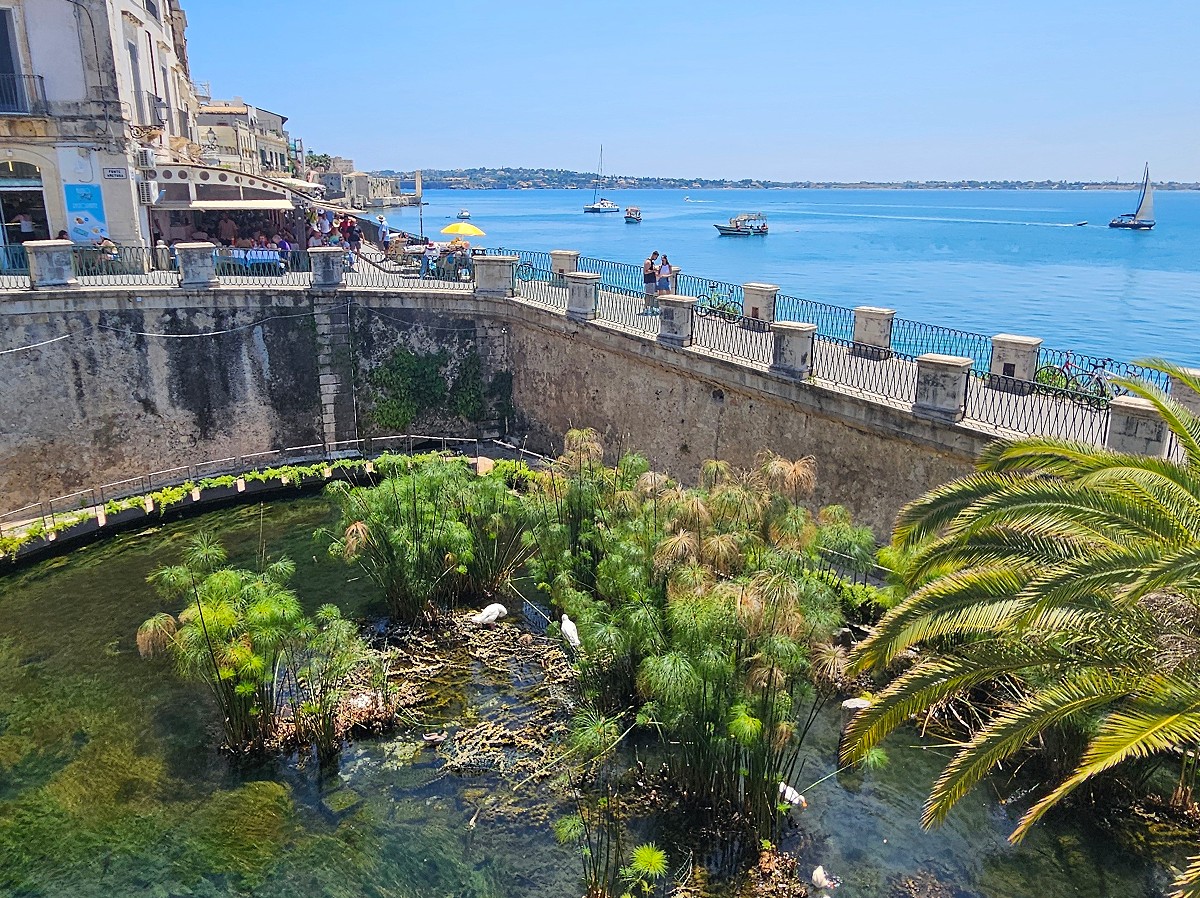
Few places in Ortigia unite mythology, nature, and geography as beautifully as Fonte Aretusa.
According to Greek legend, Arethusa was a nymph pursued by the river god Alpheus. Seeking escape, she appealed to Artemis, who transformed her into a freshwater spring. Miraculously, Alpheus followed beneath the sea from Greece to Sicily, where their waters were said to mingle eternally.
Ancient Greeks embraced the myth enthusiastically, seeing the spring as evidence of divine presence within the landscape.
Practical considerations mattered too.
Reliable freshwater sources were essential for urban survival, particularly on a small island. Fonte Aretusa therefore possessed both symbolic and practical significance throughout Ortigia's history.
It remains one of the island's most iconic landmarks.
What You'll Discover Today
Visitors encounter a tranquil freshwater basin situated only metres from the sea.
Papyrus plants sway gently above the water's surface, creating an unexpectedly lush environment amid the surrounding stone architecture. Ducks and fish move quietly below while visitors pause along the balustrades to admire the view.
The juxtaposition feels almost surreal.
Freshwater and saltwater exist side by side. Mythological imagination coexists with scientific explanation.
Many guests are particularly fascinated by the papyrus. Ortigia is one of the few places in Europe where papyrus grows naturally, adding another layer of uniqueness to the experience.
As sunlight changes throughout the day, the spring assumes different moods: reflective in the morning, vibrant at midday, and especially romantic toward evening.
Our Tips for Visiting
Visit more than once if possible.
Early mornings tend to be quieter, while evenings provide beautiful light.
Combine Fonte Aretusa with a seaside stroll toward Castello Maniace.
Don't Miss
Look carefully at the papyrus plants. They connect modern Ortigia to ancient Mediterranean traditions of writing, trade, and craftsmanship.
12. Lungomare di Levante
A Place That Shaped Ortigia
If Piazza Duomo represents Ortigia's civic heart, the Lungomare di Levante reveals its relationship with the sea.
For centuries, the eastern waterfront served as both protection and connection. Fishermen launched boats from nearby shores while merchants looked outward toward distant horizons.
Life in Sicily has always been shaped by the Mediterranean.
The sea brought prosperity through trade and hardship through invasion. It connected Ortigia to broader worlds while simultaneously defining its boundaries.
Walking the Lungomare today means participating in rituals repeated by generations of residents who sought fresh air, conversation, and moments of reflection beside the water.
What You'll Discover Today
The promenade offers some of Ortigia's most spectacular views.
Waves crash gently against limestone walls below while the Ionian Sea stretches endlessly toward the horizon. The sound of water accompanies every step.
Locals jog, stroll with family members, walk dogs, or simply sit watching the changing colours of the sea.
Photographers appreciate the uninterrupted vistas, while romantics inevitably fall in love with the atmosphere.
Unlike many coastal promenades dominated by commercial activity, the Lungomare retains a refreshing simplicity.
Its greatest attraction is the landscape itself.
Our Tips for Visiting
Late afternoon provides ideal conditions.
Bring water during warmer months and consider pausing frequently simply to enjoy the view.
The promenade pairs beautifully with Fonte Aretusa and Castello Maniace.
Don't Miss
Find a bench and spend ten minutes doing absolutely nothing except listening to the sea. Ortigia often reveals itself most fully during moments of stillness.
13. Marina and Foro Vittorio Emanuele II
A Place That Shaped Ortigia
Known simply as "the Marina" by many locals, this waterfront area has long functioned as Ortigia's social meeting place.
Historically, the harbour facilitated commerce and communication between Siracusa and the wider Mediterranean. Merchants arrived with goods, sailors exchanged news, and travellers embarked upon uncertain journeys.
As maritime life evolved, the Marina gradually transformed into a civic space where residents gathered not only for work but also for leisure.
Today, it continues to embody Ortigia's sociable character.
What You'll Discover Today
Palm trees line the waterfront while cafés and restaurants spill onto surrounding streets.
Families stroll during the evening passeggiata. Friends meet for aperitivi. Visitors pause to admire moored boats reflecting softly upon the water.
The atmosphere feels vibrant without becoming overwhelming.
There is an infectious sense of community.
Unlike destinations designed solely for tourists, the Marina remains deeply integrated into local life.
Observing its rhythms offers insight into contemporary Sicilian culture as meaningful as any museum visit.
Our Tips for Visiting
Early evening is ideal.
Consider enjoying a coffee or aperitivo while watching daily life unfold around you.
This area serves as an excellent place to rest between sightseeing stops.
Don't Miss
Observe the evening passeggiata. The simple tradition of strolling and socialising reveals the importance Sicilians place on connection and community.
14. Palazzo Bellomo Museum
A Place That Shaped Ortigia
The Palazzo Bellomo Museum demonstrates that Ortigia's artistic heritage extends far beyond antiquity.
Housed within a beautiful medieval palace adapted over successive centuries, the museum preserves important works spanning Byzantine, medieval, and Renaissance periods.
Its collections highlight the artistic exchanges that shaped Sicily following the Greek and Roman eras.
Influences from mainland Italy, Spain, and broader Mediterranean networks converge within its galleries, reflecting the island's role as a crossroads of cultures.
For visitors who assume Sicilian history ended with the classical world, Palazzo Bellomo provides a fascinating corrective.
What You'll Discover Today
The museum's scale feels intimate and approachable.
Visitors move through elegant rooms displaying paintings, sculptures, decorative arts, and religious objects selected thoughtfully rather than overwhelmingly.
Among its treasures is Antonello da Messina's celebrated Annunciation, widely regarded as one of Sicily's artistic masterpieces.
The painting's emotional subtlety and technical brilliance captivate even those with limited interest in art history.
Many guests appreciate the museum precisely because it offers respite from crowds and opportunities for slower engagement.
Our Tips for Visiting
Allow at least an hour.
The museum provides welcome refuge during particularly hot afternoons.
Take your time with individual works rather than attempting to absorb everything quickly.
Don't Miss
Spend several minutes with Antonello da Messina's Annunciation. Its quiet intensity rewards prolonged attention.
15. Castello Maniace
A Place That Shaped Ortigia
Standing proudly at Ortigia's southern tip, Castello Maniace provides a dramatic conclusion to any exploration of the island.
Constructed during the reign of Emperor Frederick II in the thirteenth century, the fortress represented both military necessity and imperial ambition. Named after the Byzantine general George Maniakes, who had previously reconquered Siracusa from Arab control, the castle occupied one of Sicily's most strategically important positions.
Frederick II envisioned fortifications that demonstrated authority as much as defensive capability.
The result remains among the finest examples of medieval military architecture in southern Italy.
Over centuries, the castle served multiple functions: fortress, royal residence, prison, and symbol of political power.
It witnessed triumphs, sieges, ceremonies, and changing rulers while maintaining its watch over the sea.
What You'll Discover Today
Approaching Castello Maniace is an experience in itself.
The fortress rises from the coastline with commanding simplicity. Massive stone walls and geometric forms convey strength without excessive ornamentation.
Inside, visitors discover expansive halls and open courtyards illuminated by Mediterranean light. Attention naturally turns outward toward breathtaking views across the sea surrounding Ortigia.
Standing upon the ramparts, one gains a profound appreciation for why this location held such strategic significance.
Sea breezes sweep through ancient openings while waves crash below.
Many guests describe the castle as unexpectedly peaceful despite its martial origins.
It feels less like a monument to war and more like a place for contemplation at the meeting point of land and sea.
Our Tips for Visiting
Late afternoon is our favourite time to visit.
The softer light enhances both the architecture and coastal views.
Wear comfortable shoes and allow sufficient time to explore without rushing.
Don't Miss
Walk to the edge of the fortress grounds and look back toward Ortigia. Seeing the island stretching northward, framed by the surrounding sea, offers one of the most memorable perspectives in all of Siracusa.
Final Thoughts: Falling Under Ortigia's Spell
People often arrive in Ortigia expecting beauty.
What they do not always expect is how deeply the island affects them.
Perhaps it is the awareness that people have lived here continuously for nearly three millennia. Perhaps it is the ease with which ancient ruins coexist beside family-run cafés and neighbourhood churches. Or perhaps it is simply the rhythm of the place itself: unhurried, welcoming, and endlessly revealing.
From Casa Bandello, we encourage our guests to resist the temptation to "complete" Ortigia.
Do not hurry from monument to monument collecting photographs. Sit in Piazza Duomo as the light changes. Wander through the Giudecca without consulting a map. Pause beside Fonte Aretusa and listen to the movement of water. Watch local families gather along the Marina at sunset.
The true magic of Ortigia lies not only in what there is to see, but in how the island invites you to experience it.
Long after specific dates and historical details begin to fade, many visitors remember something simpler: the sound of footsteps on ancient stone, the scent of sea air drifting through narrow streets, and the feeling of having discovered a place that somehow belongs both to the distant past and entirely to the present.
And that, perhaps, is Ortigia's greatest gift.