While many visitors dedicate their entire itineraries to the coastal baroque jewels, this mountain town is uniquely defined by three distinct sites that tell the story of three historical periods: a formidable ancient Greek colony, a winding medieval settlement, and a spectacular Late Baroque centre reborn from the rubble of the 1693 earthquake. It is a place where you can touch 3rd-century BC stones in the morning, marvel at aristocratic extravagance by midday, and step into the authentic rural heart of Sicily by the afternoon — all within a town small enough to cross on foot.
Morning: Akrai and the “Smallest Greek Theatre”
To understand Palazzolo Acreide, you must start at the beginning — at the archaeological park of Akrai. Founded between 664 and 663 BC by Corinthians from Syracuse (just seventy years after Syracuse itself was established), Akrai was built as an impregnable fortress-city to maintain political and military control over the Sicels of the Iblean plateau.
The two cities shared an unbreakable bond. History tells us that Dion stopped here in 357 BC on his march to Syracuse, and Hippocrates sought refuge within these walls in 214 BC. Curiously, while Roman domination marked a period of severe decline for much of Sicily, Akrai thrived, gaining immense economic importance and even minting its own coins.
Just beyond the entrance gate lies the crown jewel: what is often called the smallest Greek theatre in the world, built to hold roughly 600 spectators. Unlike many classical theatres, it is not carved directly into bedrock but rather rests on a natural slope prepared with dry stone. Built to exacting classical rules, its cavea — composed of nine wedges and twelve steps — faces perfectly north to ensure ideal lighting and protect the audience’s eyes from the sun. Its orchestra, the space where the chorus once moved, is today semicircular rather than the full circle of a Greek theatre — but that half-moon is a Roman signature, not a Greek one. When Rome later remodelled the theatre it drove a wider, raised stage into the original circular space, cutting it back to the shape you see now. Despite the alteration, its exceptional natural acoustics remain intact, and the National Institute of Ancient Drama still uses it for summer festivals featuring young classical actors.
Don’t rush back to the gate. Immediately behind the theatre sits the bouleuterion, the small semicircular council chamber where the city’s senate once met, and beyond it the line of the ancient decumanus still scores the ground. Two abandoned stone quarries flank the site: the Intagliata and the Intagliatella. Quarried by the Greeks for the very stone that built the city, they were later colonised by the living and the dead — Byzantine hermits cut chapels into their walls, and later still they served as catacombs. In the Intagliatella you can still make out a weathered relief of a heroic banquet, carved directly into the rock face, where the sacred and the everyday have been bleeding into one another for two thousand years.
The Santoni: Sicily’s Forgotten Goddess
A short walk from the main park, down a path that few coach tours bother with, lies what may be the single most extraordinary thing in Palazzolo Acreide: the Santoni. Twelve monumental reliefs, carved straight into the living rock in the 3rd century BC, depict the goddess Cybele — the Magna Mater, the great mother of the gods imported from Asia Minor — enthroned, flanked by lions, attended by priests and lesser deities.
There is nothing else like them in the entire Greek West. For centuries the local farmers who lived alongside them, not knowing who the worn, enthroned figures were, called them simply i Santoni — “the great saints” — and the name stuck. Standing before them in the quiet, with the Iblean hills rolling away on every side, you are looking at a place of worship older than almost anything you will see on the coast, dedicated to a goddess whose cult has been silent for nearly two millennia. It is the kind of site that, anywhere else, would have its own visitor centre and a queue. Here it has the wind and the lizards, and that is precisely its power.
Midday: Scenographic Baroque and Rival Brotherhoods
Following the devastating earthquake of 1693, the town was rebuilt in situ, on its exact original site. The new urban layout wrapped around the main street, where the bright Sicilian light spills into open squares, creating brilliant chromatic contrasts on the warm, honey-coloured limestone façades. It is this reconstruction that earned Palazzolo Acreide its place — alongside Noto, Modica, Scicli and Caltagirone — on the UNESCO World Heritage roll of the Late Baroque towns of the Val di Noto.
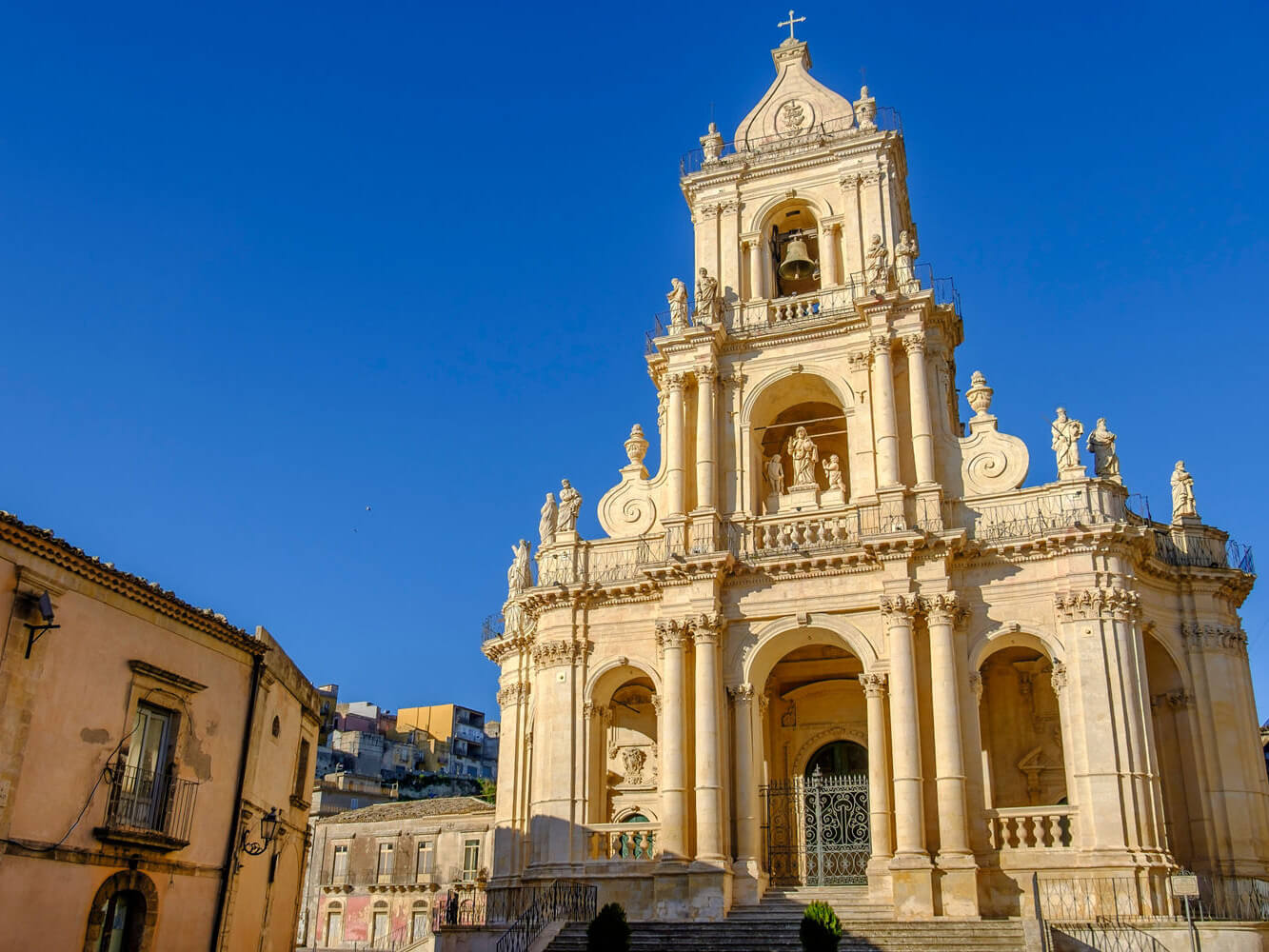
The architectural soul of the city is defined by two rival masterpieces: the Basilica di San Paolo and the Chiesa di San Sebastiano. Rising dramatically from the dense fabric of houses, neither is just a building; each serves as a highly theatrical, scenographic backdrop that visually commands not only its own square but its entire neighbourhood. San Sebastiano lifts its tiered, columned façade above a sweeping flight of steps; San Paolo answers it across the town with a bell tower and a convex frontage that seems to lean out toward you. Both stand among the core monuments singled out in the UNESCO dossier — though the World Heritage status belongs to the collective Late Baroque Towns of the Val di Noto, Palazzolo among them, rather than to the individual churches.
These monumental structures were funded by powerful, wealthy local confraternities — the brotherhoods who drove the post-earthquake reconstruction. Their devotion and historic rivalry are still palpable today during the intense summer religious festivals, when each saint’s faithful pour into the streets in a centuries-old contest of pride and pageantry.
The Chiesa dell’Annunziata
Slightly apart from the two great rivals, and easy to walk past, stands the Chiesa dell’Annunziata — and you should not walk past it. Its portal is one of the most photographed pieces of baroque stonework in the province: four great spiral Solomonic columns, twisted like barley sugar and wrapped in carved vine leaves, grapes, and putti, framing the doorway in a riot of movement that turns solid stone into something almost liquid. It is a small church with a façade that punches far above its size, and a perfect example of how Palazzolo’s baroque is at its best not in grand gestures but in these sudden, exuberant details tucked into the side streets.
The Medieval Palatiolum
As you walk the winding streets connecting these great churches, you’ll pass through the medieval footprint of the town. Built near ancient Akrai on a strategic, defensible rocky spur, this area once housed an imperial palace — a palatium — from which the medieval town drew its name, Palatiolum. The lanes here are narrower and older than the open baroque squares, and they remember a Palazzolo that existed long before 1693 redrew the map.
The Longest Baroque Balcony in the World
As you stroll down Via Garibaldi, prepare to look up. At number 127 stands Palazzo Caruso — historically known as Palazzo Judica — an 18th-century noble residence that boasts what is widely considered the longest baroque balcony in the world. This breathtaking stretch of undulating wrought iron is supported by twenty-seven finely sculpted stone corbels. Take your time walking beneath it: each bracket depicts a different figure. You will see funny, irreverent masks with grotesque expressions, anthropomorphic faces, and mythological creatures like griffins and serpents. It is the ultimate expression of late baroque aristocratic extravagance, designed specifically to awe anyone walking the street below — exactly as it is awing you now.
Lunch: The Taste of the Mountains
The culinary soul of Palazzolo Acreide contrasts beautifully with the seafood-heavy menus of the coast. Up here, the air is cooler and the land provides rich, earthy ingredients. The undisputed star of the local table is the Salsiccia di Palazzolo Acreide — a traditional pork sausage flavoured with wild fennel, sea salt, black pepper, and wine, and protected as a Slow Food Presidium. (You’ll also come across a spicier version laced with red chilli, but black pepper is the authentic backbone of the recipe.) It is sold in long coils by butchers who have made it the same way for generations, and grilled over coals it is the single most Palazzolo thing you can eat. Find a local trattoria tucked into the alleys and order dishes featuring foraged Iblean truffles, wild mushrooms, and shavings of local Ragusano DOP cheese.
Before continuing your walk, stop by the historic Pasticceria Corsino, established in 1868 and still run by the same family. It is widely regarded as one of the finest pastry shops in all of Sicily, making it the perfect spot for an espresso and a freshly filled ricotta cannolo, or for the almond sweets and mostaccioli that the house has been turning out for over a century and a half.
Afternoon: A Time Capsule of Peasant Life
Spend your afternoon delving into authentic Sicilian folklore at the Casa Museo Antonino Uccello. Inaugurated in 1971, it is one of the very first ethnographic museums in Sicily. It was born from the obsessive passion of Antonino Uccello, a Sicilian teacher and poet who, after spending much of his life in northern Italy, returned home driven by a love for his homeland to preserve its fading rural traditions.
The museum is housed within the 18th-century noble Palazzo Ferla, wrapping through the entire ground floor up to the founder’s former residence on the top floor. Inside, it protects a vast, evocative collection of peasant life: shepherds’ tools, daily ceramics, original furniture in the fattore (farm manager) room, traditional nativity figurines, and theatrical pupi (puppets). Be sure to admire the famous Sicilian carts, the carretti. While today we view their intricate paintings of historical, religious, and chivalric subjects as pure art, the museum highlights a practical truth: those vibrant, thick layers of paint were originally applied as a highly functional sealant to protect the wooden structure from the harsh Sicilian elements.
The Festivals: When the Brotherhoods Take the Streets
If you can time your visit to a feast day, do. Palazzolo’s two great brotherhoods each have their moment, and the old rivalry between them turns the town inside out. The Feast of San Paolo falls at the end of June (the 28th and 29th); San Sebastiano takes his turn on the 10th of August. Both reach the same breathtaking climax: the Sciuta — literally “the exit” — at one o’clock in the afternoon, when the great doors of the church are flung open and the saint’s float bursts out into the square amid a roar from the crowd, a storm of nzareddi (coloured paper streamers fired into the air), and fireworks set off in broad daylight. It is one of Sicily’s most famous festival traditions, drawing crowds from across the island. To stand in either square at that moment is to understand that in Palazzolo, the baroque was never just architecture — it was theatre built for exactly this.
Beyond the Town: The Necropolis of Pantalica
If Palazzolo whets your appetite for the deep past, the most rewarding excursion in the area lies just to the north, reached through the neighbouring village of Ferla, barely fifteen minutes from the baroque centre. The Necropolis of Pantalica is one of the most important prehistoric sites in the Mediterranean — and, together with Syracuse, a UNESCO World Heritage Site in its own right since 2005.
Strung along the limestone cliffs above the Anapo river gorge are more than five thousand tombs, cut by hand into the rock between roughly the 13th and 7th centuries BC. They are the work of the Sikels, the indigenous people who retreated inland to this natural fortress as Greek colonists pushed up from the coast. At the centre of the plateau still stands the Anaktoron, the megalithic “prince’s palace” that once governed the settlement. Much later, in the troubled Byzantine centuries, fugitives returned to these same caves, hollowing some of the ancient tombs into dwellings and tiny rock-cut oratories — so that the cliffs carry the layered memory of two separate flights into the wilderness, a thousand years apart.
Pantalica is not a museum but a wild nature reserve, free to enter and explored entirely on foot. The most convenient access is the Sella di Filiporto entrance on the Ferla side, from which paths lead to the necropolis, the Anaktoron, and down into the green floor of the gorge, where the bed of the long-dismantled Syracuse–Vizzini railway now makes an easy, shaded walking trail along the river. Wear proper walking shoes, carry plenty of water, and allow at least two to three hours — more if you intend to descend into the valley. Spring and autumn are ideal; in high summer the exposed plateau is punishingly hot, so start early. Because Ferla sits right beside Palazzolo, the two pair naturally into a single, deeply rewarding day: ancient Greek Akrai and baroque Palazzolo in the morning, the Sikel cliffs of Pantalica in the cooler afternoon.
Planning Your Day Trip
Getting There: A highly scenic 35-minute drive from Casa Bandello. The road leaving Noto climbs steadily into the mountains, offering dramatic views of limestone ravines and ancient olive groves.
When to Visit: May and June are spectacular, not only for the mild weather but to catch the classical youth theatre festival at Akrai. Late summer is also excellent — at roughly 650 metres above sea level, Palazzolo offers a refreshing escape from the coastal heat.
What to Bring: Comfortable walking shoes are essential for navigating the uneven dry stones of the archaeological park and the town’s steep baroque staircases. Take a hat and water for the walk out to the Santoni, which is exposed.
Parking: Leave the car in one of the squares of the lower baroque town and continue on foot; the historic centre is compact and best explored slowly. For Akrai and the Santoni there is parking at the archaeological park itself, a short drive up from the centre.
By the time you point the car back toward the coast, the light will be going long and gold over the Iblean hills, and Palazzolo’s three ages — Greek, medieval, baroque — will have folded into a single afternoon. The drive back down to the peaceful sanctuary of Casa Bandello takes barely half an hour, but you will arrive feeling as though you have travelled through two and a half thousand years.