Many travellers know Siracusa for Ortigia, its enchanting island heart filled with honey-coloured Baroque façades and romantic piazzas. And rightly so—Ortigia deserves every bit of admiration it receives. But limiting your visit to the island alone means overlooking another side of the city entirely: one of vast Greek theatres carved into limestone hillsides, Roman arenas built for spectacle, mysterious underground catacombs, ancient quarries reclaimed by nature, and sacred places where faith continues to shape daily life.
Few cities in Sicily contain so many layers of history within such a compact area. Founded by Greek settlers from Corinth in 734 BC, Siracusa grew into one of the most powerful cities of the Mediterranean. Cicero would later describe it as "the greatest Greek city and the most beautiful of them all." It resisted Athenian invasion, flourished under Roman rule, became an important Christian centre, and continued evolving through Byzantine, Arab, Norman and modern periods.
From Casa Bandello, one of the reasons we love recommending Siracusa is that it offers something for every kind of traveller. History enthusiasts can spend hours tracing the footsteps of ancient civilizations. Families can explore caves and enormous theatres that ignite children's imaginations. Photographers will find endless opportunities in dramatic landscapes and changing light. And those who simply enjoy wandering will discover a city that rewards curiosity at every turn.
This first part of our guide explores six of Siracusa's most remarkable sites beyond Ortigia—places that reveal why this city has fascinated visitors for more than two and a half millennia.
Reaching Siracusa from Noto
One of the great advantages of staying in Noto is how close Siracusa really is. By car, the journey usually takes between 35 and 40 minutes along the A18/E45 motorway. The route is straightforward and well signposted, making it an easy excursion even for guests unfamiliar with driving in Sicily. Parking is generally available near the archaeological area, especially if you arrive before mid-morning.
Regional trains also connect Noto and Siracusa several times throughout the day. The journey takes roughly half an hour and removes the stress of parking entirely. Siracusa's railway station is conveniently located close to the city centre and within easy reach of local buses and taxis.
For those who prefer public transport, Interbus coaches provide another reliable option. Although the journey is slightly longer, the buses run frequently and are ideal for travellers who wish to sit back and enjoy the changing Sicilian landscape.
Whichever method you choose, Siracusa is one of the easiest and most rewarding day trips from Noto.
1. Neapolis Archaeological Park
A Place That Shaped Siracusa
If Ortigia represents the elegant soul of Siracusa, Neapolis Archaeological Park embodies its ancient power.
The word "Neapolis" means "new city," and this district developed as Siracusa expanded beyond the original island settlement during the Greek period. What visitors encounter today is not a single monument but an extraordinary concentration of archaeological treasures spanning several centuries of history. It is one of the most important archaeological parks in all of Italy and offers perhaps the clearest picture of how Siracusa evolved from Greek metropolis to Roman provincial capital.
During the fifth and fourth centuries BC, Siracusa was among the richest and most influential cities in the Mediterranean. Its rulers commanded vast armies and fleets, philosophers debated within its walls, and artists and engineers contributed to an urban landscape designed to impress both citizens and foreign visitors. Even mighty Athens underestimated Siracusa's strength during the disastrous Sicilian Expedition of 415–413 BC, a defeat that altered the course of the Peloponnesian War.
What makes Neapolis so remarkable is that it allows visitors to experience several chapters of this story within a single landscape. Greek theatres, Roman arenas, sacrificial altars, and ancient quarries coexist beneath pine trees and Mediterranean vegetation. Rather than presenting isolated ruins behind museum glass, the park reveals how public life unfolded in antiquity: where people gathered, worshipped, celebrated, mourned, and entertained themselves.
Walking through Neapolis, it becomes impossible to think of ancient Siracusa as merely a distant abstraction. Instead, it emerges as a vibrant city filled with ambition, creativity, faith, and everyday human activity.
What You'll Discover Today
The first thing many visitors notice is the scale.
Wide pathways wind gently through an open landscape scented with pine resin, wild herbs, and sun-warmed limestone. Ancient monuments appear gradually, often revealed through clusters of trees or dramatic changes in elevation. Unlike many archaeological sites where ruins can feel repetitive, Neapolis constantly surprises.
One moment you are standing inside one of the largest Greek theatres ever built. A few minutes later, you find yourself staring into a towering limestone cavern known as the Ear of Dionysius. Further on lies the immense Roman Amphitheatre, followed by the astonishing remains of the Altar of Hieron II. Between these monuments stretch the Latomie—ancient stone quarries transformed over centuries into lush gardens where nature has softened the harsh scars left by human industry.
The park appeals equally to seasoned history enthusiasts and first-time visitors. Children often delight in the sheer adventure of climbing pathways and discovering caves, while adults appreciate the extraordinary concentration of historical significance.
There is also something deeply moving about the landscape itself. Ancient stones sit beneath umbrella pines that sway in the breeze. Birds sing where crowds once gathered to witness dramas and spectacles. The city hums in the distance while this pocket of antiquity invites slower rhythms of observation and imagination.
Neapolis is not simply somewhere to tick off a list. It is a place to wander thoughtfully and allow Siracusa's many layers to reveal themselves.
Our Tips for Visiting
Arrive as early as possible, especially from May through September. Temperatures rise quickly, and some sections offer limited shade.
Allow at least three hours, though history lovers could easily spend half a day here. Comfortable footwear, water, and sun protection are essential. Consider hiring an audio guide or joining a guided tour to fully appreciate the stories behind the monuments.
Combining Neapolis with the nearby Paolo Orsi Museum creates one of the most rewarding cultural days in southeastern Sicily.
Don't Miss
Many visitors hurry between the major landmarks, but some of the most memorable moments happen in the quieter spaces between them. Pause beneath the pine trees, look across the ancient quarries, and imagine how this bustling district once sounded when thousands of Siracusans gathered here.
2. The Greek Theatre
A Place That Shaped Siracusa
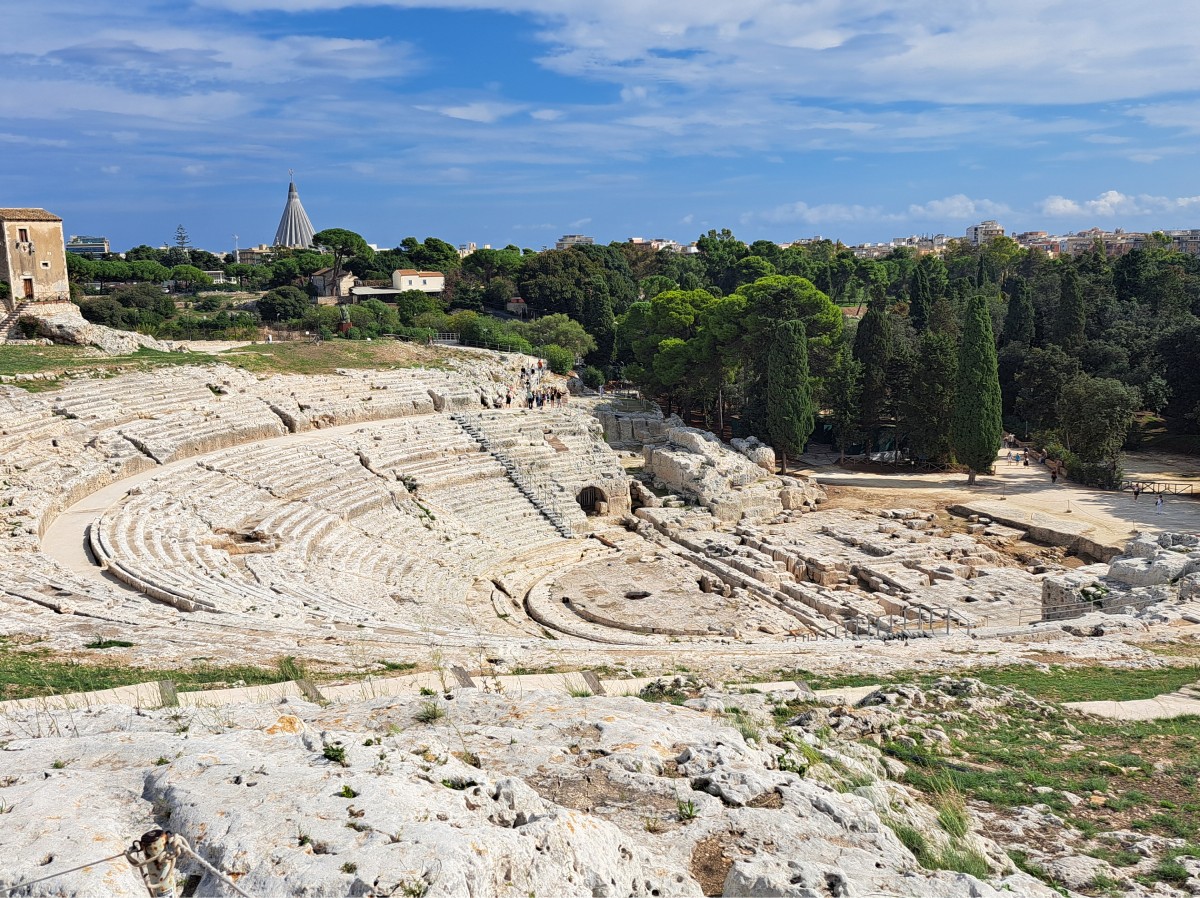
Carved directly into the rocky slope of Temenite Hill, the Greek Theatre is one of the most spectacular surviving theatres of the ancient world.
The earliest version dates to the fifth century BC, during a period when Siracusa was flourishing culturally and politically. Later expansions under Hieron II transformed it into the vast structure visitors admire today. Capable of accommodating thousands of spectators, it served not merely as a venue for entertainment but as an essential civic institution.
In ancient Greek society, theatre occupied a role far more significant than modern audiences often realise. Performances formed part of religious festivals dedicated to Dionysus, god of wine, fertility, and dramatic arts. Tragedies and comedies explored themes of justice, power, morality, family loyalty, and the fragile relationship between humanity and fate.
Imagine Siracusans ascending these stone steps nearly 2,300 years ago. Merchants sat beside politicians, sailors beside aristocrats. Entire communities gathered to witness the works of playwrights such as Aeschylus and Euripides, engaging collectively with stories that questioned what it meant to be human.
It is believed that Aeschylus himself may have presented works here, adding another extraordinary dimension to the site's significance.
Few places allow visitors to stand so close to the origins of Western theatre.
What You'll Discover Today
Even before understanding its history, the theatre commands admiration through its sheer beauty.
Rows of limestone seating sweep gracefully around the hillside in a vast semicircle, framing views across the surrounding landscape. From higher levels, visitors can glimpse the city beyond while appreciating the remarkable engineering required to carve such an immense structure into solid rock.
Despite centuries of weathering and adaptation, the theatre retains a striking sense of harmony. Its proportions feel instinctively right, demonstrating the Greek pursuit of balance between architecture and nature.
Many visitors instinctively lower their voices upon entering. The acoustics remain impressive, and it takes little imagination to picture actors projecting dramatic speeches across attentive crowds.
If you happen to visit during the annual cycle of classical performances, usually held in late spring and early summer, the experience becomes truly magical. As dusk settles over Siracusa, ancient tragedies and comedies return to the stage in the very setting for which they were intended. Modern audiences laugh, cry, and reflect beneath the stars, continuing traditions interrupted only briefly across two millennia.
Even without performances, there is an extraordinary emotional resonance here. Few monuments communicate the intellectual and artistic achievements of ancient civilization so powerfully.
Our Tips for Visiting
Morning visits offer cooler temperatures and gentler light. Late afternoon provides beautiful conditions for photography.
If your travel dates coincide with the annual Greek Theatre Festival, we strongly encourage booking tickets in advance.
Take time to climb higher into the seating area. The changing perspectives reveal just how monumental the theatre truly is.
Don't Miss
If performances are scheduled during your stay, attend one—even if you don't speak Italian fluently. The atmosphere alone is unforgettable, and many guests later describe it as the highlight of their Sicilian holiday.
The Ear of Dionysius
Place That Shaped Siracusa
Few places in Siracusa inspire as much curiosity as the Ear of Dionysius.
This extraordinary limestone cave derives its evocative name from the artist Caravaggio, who visited Siracusa in 1608. According to local legend, the tyrant Dionysius I imprisoned enemies within the quarry and exploited the cave's unusual acoustics to overhear their conversations. Whether historically accurate or not, the tale has captivated imaginations for centuries.
The cave itself almost certainly originated as an ancient stone quarry. The limestone extracted here helped build the expanding city, linking the site directly to Siracusa's development. Over time, quarrying activities created the soaring, ear-shaped chamber visitors explore today.
The myth reflects broader truths about ancient tyranny, surveillance, and power. Dionysius I ruled Siracusa during a turbulent era marked by military conflicts and political intrigue. Stories portraying him as suspicious and calculating endured long after his death.
Whether viewed as geological wonder, archaeological feature, or legendary prison, the Ear of Dionysius reveals how history and storytelling often intertwine.
What You'll Discover Today
Stepping inside the cave can be surprisingly dramatic.
The chamber rises nearly twenty-three metres high, narrowing and twisting upward toward an opening that admits shafts of light from above. The resulting shape produces astonishing acoustic effects. Even whispers can travel unexpectedly through the space, while footsteps and voices echo with haunting clarity.
Children often find the experience delightfully mysterious. Adults, meanwhile, marvel at the immense scale and cool atmosphere hidden beneath the Sicilian sun.
There is something theatrical about the experience. Visitors instinctively test the acoustics, exchanging astonished glances as sounds bounce across the cavern walls. Yet moments of silence can be equally powerful. Standing quietly, listening to distant echoes fade into stillness, creates an almost meditative sensation.
The cave also offers welcome respite during hot summer days. Its cooler temperatures provide temporary relief before returning to the brighter landscapes of Neapolis.
For many guests, this is the site they remember most vividly—not because of grandeur alone, but because it engages the senses so completely.
Our Tips for Visiting
Visit early or later in the day if possible to avoid peak crowds.
Remain patient inside; the atmosphere changes dramatically once larger groups move on.
Photographers should expect challenging lighting conditions but extraordinary opportunities for creative compositions.
Don't Miss
Stand quietly near the centre of the chamber after a group passes through. The gradual return of silence allows you to appreciate why this cave inspired legends that continue to fascinate visitors centuries later.
The Roman Amphitheatre
A Place That Shaped Siracusa
The Roman Amphitheatre reminds us that Siracusa did not cease to matter after the decline of Greek power.
When Rome absorbed Sicily into its growing empire, Siracusa retained considerable importance as an administrative and commercial centre. Roman rulers adapted the city to suit their own cultural values and public expectations, constructing monuments designed for mass entertainment and civic display.
Built during the Imperial period, probably in the third century AD, the amphitheatre reflected Roman priorities. Unlike Greek theatres devoted primarily to dramatic performances, amphitheatres hosted gladiatorial contests, staged hunts involving exotic animals, athletic competitions, and public spectacles intended to demonstrate imperial authority.
These events reinforced social cohesion while providing diversion for large audiences. Attendance transcended class divisions, allowing citizens from various backgrounds to participate collectively in Roman civic life.
The amphitheatre therefore represents more than architectural adaptation. It illustrates how Siracusa evolved, absorbing new influences while remaining one of Sicily's principal urban centres.
What You'll Discover Today
Although less intact than Rome's Colosseum, the amphitheatre possesses a quieter dignity that rewards attentive visitors.
Its elliptical outline remains clearly visible, allowing guests to appreciate the ingenuity of Roman engineering. Portions of seating areas, entrances, and the central arena survive, inviting reflection on the spectacles once unfolding here.
Interpretive panels help reconstruct the monument's original appearance, but imagination also plays an important role. Picture crowds arriving through stone passageways, vendors selling refreshments, officials occupying privileged positions, and gladiators preparing themselves behind the scenes.
Many visitors are surprised by the contrast between this structure and the nearby Greek Theatre. The Greek monument feels integrated harmoniously into the landscape, encouraging contemplation. The Roman Amphitheatre communicates order, control, and spectacle.
Because it attracts fewer crowds than neighbouring attractions, the atmosphere can feel particularly peaceful. It becomes easier to linger, observe details, and appreciate the complexity of Siracusa's multicultural heritage.
Our Tips for Visiting
Explore the amphitheatre as part of the broader Neapolis route.
Pause to compare Greek and Roman architectural philosophies. The differences reveal fascinating insights into two influential civilizations.
Bring water and sun protection, as shaded areas may be limited.
Don't Miss
Find a quiet spot overlooking the arena and imagine the transformation of Siracusa across centuries—from Greek powerhouse to Roman provincial city—without ever losing its importance.
5. The Altar of Hieron II
A Place That Shaped Siracusa
Among all the monuments of Neapolis, the Altar of Hieron II is perhaps the easiest to underestimate.
At first glance, its surviving remains appear deceptively modest. Yet this enormous structure was once among the largest sacrificial altars ever constructed in the Greek world. Built during the reign of Hieron II in the third century BC, it measured approximately two hundred metres in length and served as the setting for grand religious ceremonies involving the entire community.
Hieron II governed Siracusa during a period of relative stability and prosperity. His long reign strengthened the city's economy and cultural prestige while navigating the complicated politics of an expanding Roman Republic.
Religion in ancient Greece extended far beyond private belief. Public sacrifices reinforced civic identity, affirmed relationships between citizens and gods, and demonstrated the generosity of rulers sponsoring ceremonies. Ancient sources suggest hundreds of bulls may have been sacrificed here during important festivals.
The altar therefore symbolised political authority, religious devotion, and communal participation on an astonishing scale.
What You'll Discover Today
Visitors encounter long stone foundations stretching across the landscape—silent remnants of ceremonies once witnessed by thousands.
Understanding what stood here requires imagination, but this process can be profoundly rewarding. Picture priests conducting rituals, smoke rising toward the sky, musicians performing, and crowds gathering in celebration.
The monument reveals aspects of ancient life often overshadowed by theatres and temples. It reminds us that religion shaped daily experience and public identity in ways difficult for modern audiences to fully comprehend.
Many guests initially spend only a few moments here before realising the altar's significance. Those who pause and absorb its scale often leave deeply impressed.
There is also a striking contrast between the monument's original function and today's tranquil surroundings. Birds move through grasses where elaborate ceremonies once unfolded, emphasising the passage of time.
Our Tips for Visiting
Take advantage of guidebooks or audio guides to understand what you're seeing. Do not rush past simply because fewer architectural details survive. Viewing the altar after exploring the Greek Theatre often helps contextualise the social and religious life of ancient Siracusa.
Don't Miss
Stand at one end and look toward the other. Only then does the extraordinary scale of this ancient altar become fully apparent.
The Catacombs of San Giovanni
A Place That Shaped Siracusa
Hidden beneath modern Siracusa lies another city entirely.
The Catacombs of San Giovanni developed between the third and sixth centuries AD, during a transformative period when Christianity spread throughout the Roman Empire. Long before Christianity became dominant, believers in Siracusa established extensive underground burial networks reflecting evolving religious practices and communal identities.
These catacombs rank among the largest and most important in Sicily.
Unlike Roman catacombs carved into softer volcanic soils, those in Siracusa were excavated within limestone, creating broad galleries connected by smaller passageways. Family tombs, communal burial areas, and commemorative spaces reveal how early Christians honoured their dead while expressing hope in resurrection.
Tradition also links Siracusa to Saint Lucy, the city's beloved patron saint martyred during Roman persecutions in the early fourth century. Although historical evidence remains debated, her enduring presence deepens the spiritual resonance surrounding these subterranean spaces.
Descending into the catacombs means entering a world shaped by faith, remembrance, grief, and resilience.
What You'll Discover Today
Guided tours lead visitors through surprisingly spacious corridors lined with burial niches carved directly into the stone.
The atmosphere below ground differs profoundly from Siracusa's sunlit archaeological parks. Temperatures cool noticeably. Sounds soften. Conversation becomes quieter and more reflective.
Rather than inspiring fear, the catacombs often evoke contemplation. These were not places of horror but sacred environments where communities maintained bonds with loved ones and affirmed shared beliefs.
Guides explain burial customs, symbolic motifs, and the social structures reflected in different tomb arrangements. Visitors discover that early Christian communities were diverse and organised, encompassing families, clergy, and ordinary citizens alike.
Many guests emerge unexpectedly moved. After exploring theatres devoted to entertainment and arenas celebrating spectacle, the catacombs offer intimate insight into the emotional realities of ancient life: love, loss, hope, and memory.
They remind us that history is ultimately composed of individual human experiences.
Our Tips for Visiting
Guided tours are required and greatly enhance understanding.
The cool underground temperatures make the catacombs particularly appealing during hot afternoons.
If enclosed spaces cause discomfort, inform guides beforehand and proceed at your own pace.
Don't Miss
Notice the extraordinary silence. For many visitors, the most memorable aspect of the catacombs is not a particular tomb but the profound stillness that invites reflection on lives lived nearly two thousand years ago.