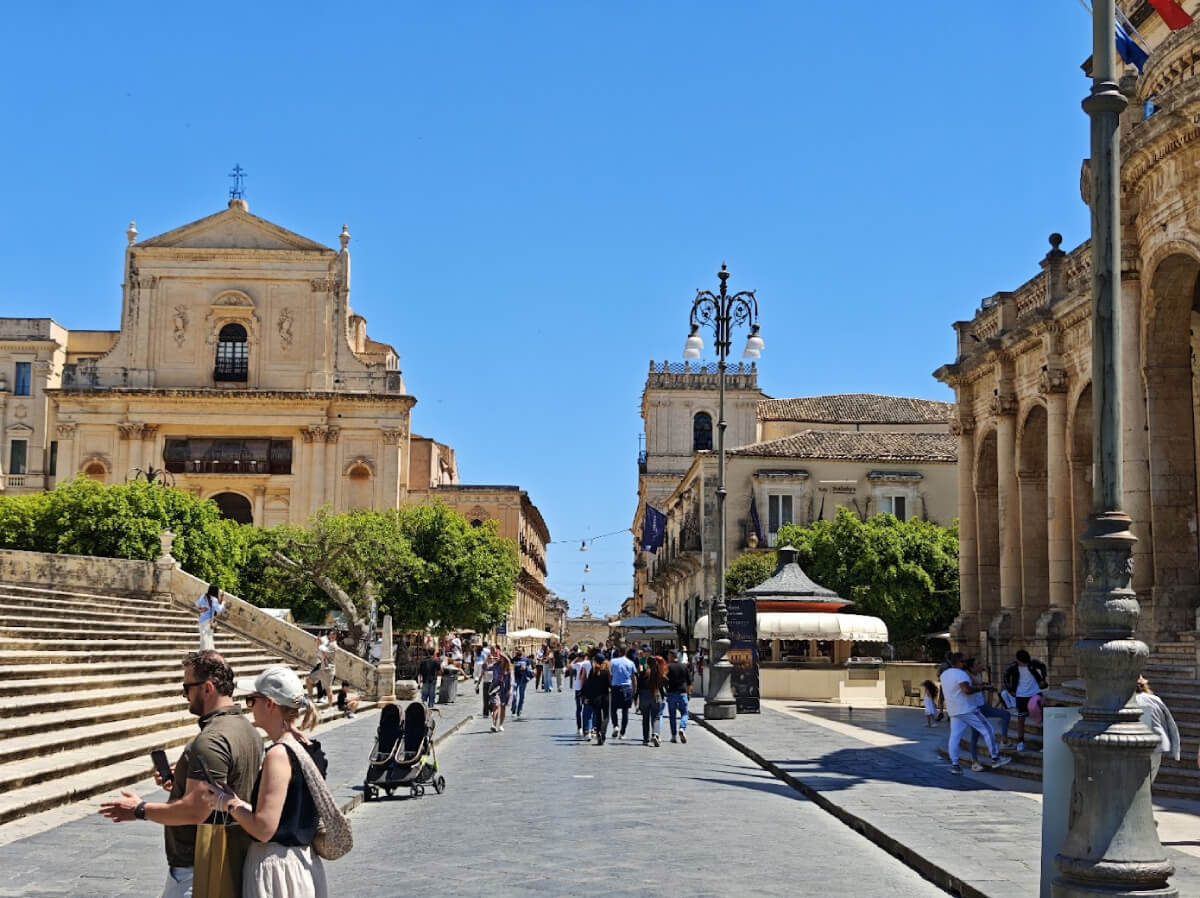
Now we arrive at the heart of the city.
Piazza Municipio is the point where Noto's architects, noble families, religious institutions, and civic leaders all left their mark. Here, some of the town's most important buildings stand in conversation with one another, creating a space that feels both monumental and welcoming.
For many visitors, this is the moment when admiration turns into genuine affection.
The city no longer feels like a collection of beautiful buildings.
It begins to feel like a place.
4. Piazza Municipio and the Cathedral of San Nicolò
The Heart of Noto
There are many impressive piazzas in Sicily, but few achieve the harmony and balance of Piazza Municipio.
The square serves as the civic and spiritual centre of Noto, bringing together the city's most important religious and governmental institutions within a single architectural composition. The broad staircase rising towards the cathedral immediately commands attention, while the surrounding buildings create a sense of order and grandeur that perfectly reflects the ambitions of the eighteenth-century reconstruction.
When the city was rebuilt after the earthquake of 1693, planners deliberately positioned the cathedral at the highest point of the square. The result is a setting that feels theatrical without becoming overwhelming. Every visitor approaching from Corso Vittorio Emanuele experiences the same gradual reveal, as the staircase and façade emerge into view and dominate the urban landscape.
More than three centuries later, Piazza Municipio remains the place where Noto gathers to celebrate, commemorate, and simply enjoy daily life. Religious festivals, concerts, weddings, civic ceremonies, and evening strolls all unfold here beneath the watchful presence of the cathedral.
The Story of the Cathedral
The Cathedral of San Nicolò is often regarded as the symbol of modern Noto.
Construction began in the early eighteenth century as part of the ambitious rebuilding programme that transformed the city following the earthquake. The architects responsible sought to create a building that would express both religious devotion and civic confidence, reflecting the optimism of a community rebuilding itself after catastrophe.
The cathedral's imposing façade, with its twin bell towers and commanding central section, became one of the defining features of the city's skyline. For generations, it stood as a testament to the skill and ambition of the builders who helped create what we now know as Baroque Noto.
Yet the cathedral's story contains a dramatic modern chapter as well.
In 1996, a significant portion of the structure unexpectedly collapsed. The dome and sections of the roof fell inward, shocking residents and visitors alike. For many people in Noto, the collapse felt like a personal loss. The cathedral was not simply an architectural monument; it was part of the city's identity.
What followed was one of the most important restoration projects in modern Sicily. Engineers, architects, historians, and craftsmen worked together to rebuild the structure while respecting its historical character. After years of painstaking work, the cathedral reopened and once again assumed its place at the centre of city life.
Today, visitors see not only a beautiful church but also a powerful symbol of resilience and renewal.
What You'll Discover Today
The broad staircase leading to the cathedral is one of the most photographed locations in Noto, and for good reason.
From the lower part of Piazza Municipio, visitors can appreciate the full composition of the façade and its relationship to the surrounding buildings. Climbing the steps gradually changes the perspective, revealing details that are easily missed from below.
Inside, the atmosphere differs from many older Sicilian churches. Because much of the interior was reconstructed following the collapse, visitors often notice a sense of brightness and openness. Light enters through the restored structure and illuminates the spacious nave, creating an environment that feels both historic and contemporary.
Whether you are interested in architecture, history, photography, or simply beautiful places, the cathedral rewards time and attention.
This is not a landmark to admire quickly before moving on.
It is a place to pause and appreciate.
Our Tips for Visiting
Visit the cathedral at least twice if possible.
The atmosphere changes dramatically throughout the day as the light shifts across the façade and fills the piazza. Morning often provides softer conditions for photography, while late afternoon bathes the limestone in warm golden tones.
If the cathedral is open, take time to explore the interior rather than focusing exclusively on the exterior architecture.
Don't Miss
Standing halfway up the staircase and looking back across Piazza Municipio.
The view perfectly captures the relationship between the cathedral and the city it was built to serve.
5. Palazzo Ducezio
The Civic Face of Noto
Directly opposite the cathedral stands Palazzo Ducezio, the elegant building that houses Noto's municipal government.
Named after Ducezio, the legendary Sicel leader associated with the ancient history of the region, the palace represents the civic counterpart to the religious authority embodied by the cathedral. Together, the two buildings create one of the most balanced urban compositions in Sicily, reflecting the close relationship between church and civic life that characterised many Baroque cities.
Designed by the architect Vincenzo Sinatra, one of the key figures involved in rebuilding Noto, Palazzo Ducezio demonstrates the refinement and restraint that distinguish the city's architecture. While undeniably elegant, it avoids excessive ornamentation, relying instead on proportion, symmetry, and harmonious design.
For more than two centuries, the building has served as the administrative heart of the city.
What You'll Discover Today
Visitors entering Palazzo Ducezio often discover one of Noto's most underrated attractions.
The celebrated Hall of Mirrors, inspired by similar ceremonial spaces found in European palaces, offers a glimpse into the civic prestige that accompanied Noto's rise during the eighteenth and nineteenth centuries. Decorative details, elegant proportions, and carefully designed interiors reflect the confidence of a city determined to establish itself as one of Sicily's leading centres.
Equally rewarding are the views available from the palace. Looking across Piazza Municipio towards the cathedral provides a perspective that many visitors miss, yet it is one of the best ways to appreciate the urban harmony that defines the city.
The palace reminds us that Noto was not built solely for religious purposes.
It was also designed as a functioning administrative and cultural centre.
Our Tips for Visiting
Check opening hours in advance, as access may occasionally vary depending on municipal activities.
If the Hall of Mirrors is open, it is well worth the visit.
Don't Miss
The opportunity to view the cathedral from the palace. Few viewpoints illustrate the relationship between civic and religious architecture so clearly.
6. Palazzo Nicolaci di Villadorata
Sicilian Baroque at Its Most Imaginative
If the cathedral represents the spiritual heart of Noto and Palazzo Ducezio its civic centre, Palazzo Nicolaci di Villadorata showcases the creativity and ambition of the city's aristocratic families.
Built during the eighteenth century for the powerful Nicolaci family, the palace remains one of the most extraordinary examples of Baroque residential architecture in Sicily. The family traced its origins to noble roots and played an important role in the social and political life of the region.
Their residence was intended not merely as a home, but as a public statement of wealth, influence, and cultural sophistication.
The result is one of the most distinctive buildings visitors will encounter anywhere in Sicily.
What You'll Discover Today
The palace is famous above all for its remarkable balconies.
Supported by carved figures that seem almost alive, they transform the façade into a celebration of imagination and craftsmanship. Lions, horses, mermaids, winged creatures, cherubs, and fantastical masks emerge from the stone, each displaying the skill and humour of the artisans who created them.
These sculptures are among the most photographed details in Noto, yet they deserve closer attention than many visitors give them. The carvings reveal a playful side of Sicilian Baroque architecture that contrasts beautifully with the more restrained elegance of the cathedral and civic buildings.
Inside, visitors can explore rooms that offer insight into aristocratic life during the centuries following the reconstruction of Noto. Elegant furnishings, decorative ceilings, and historic interiors help tell the story of the families who shaped the city's development.
Our Tips for Visiting
Spend time examining the façade before entering.
Many people rush inside and overlook the extraordinary sculptural details that make the palace famous.
Don't Miss
The balcony supports.
Few examples of Baroque stone carving anywhere in Europe display such creativity and personality.
7. Via Nicolaci
Noto's Most Elegant Street
Extending from the palace is Via Nicolaci, a street often considered one of the most beautiful in Sicily.
Its proportions, architectural harmony, and gentle slope create a visual composition that feels almost perfectly balanced. Noble palaces line both sides, their balconies and façades contributing to a sense of refinement that has become synonymous with Noto itself.
Although the street is beautiful throughout the year, it is internationally famous for hosting the Infiorata di Noto, the annual flower festival during which artists transform the roadway into a vast carpet of floral designs.
For a few days each spring, Via Nicolaci becomes one of the most photographed streets in Italy.
What You'll Discover Today
Even outside the festival period, Via Nicolaci is worth lingering in.
The street offers excellent opportunities to appreciate the consistency of Noto's architecture and the quality of its urban design. Looking uphill or downhill reveals carefully framed perspectives that seem almost painterly.
In the early morning and evening, when visitor numbers decrease, the atmosphere becomes particularly enchanting. Residents return home, conversations drift from open windows, and the street regains the quiet elegance that has characterised it for centuries.
Our Tips for Visiting
Walk the street more than once if possible.
The changing light throughout the day dramatically alters the appearance of the stone and architectural details.
Don't Miss
Looking back towards Palazzo Nicolaci from the lower end of the street.
It is one of the classic views of Noto.
8. Noto from Above: San Carlo and Santa Chiara
Understanding the City from the Rooftops
While Noto is beautiful from street level, some of its greatest pleasures are found above the rooftops.
Several churches offer elevated viewpoints that help visitors appreciate the city's remarkable urban plan and the landscape that surrounds it.
Two of the most rewarding are the bell tower of San Carlo al Corso and the terrace of Santa Chiara.
What You'll Discover Today
From the bell tower of San Carlo, visitors enjoy sweeping views along Corso Vittorio Emanuele and across the rooftops of the historic centre. The regularity of the street plan becomes immediately apparent, highlighting the careful thinking that shaped the reconstruction.
Santa Chiara offers a different perspective. From its terrace, domes, bell towers, and honey-coloured façades stretch towards the horizon, while the surrounding countryside reminds visitors that Noto remains closely connected to the agricultural landscape that has sustained the region for centuries.
These viewpoints reveal aspects of the city that are impossible to understand from ground level alone.
Our Tips for Visiting
Visit during the late afternoon when the stone begins to glow with the warm colours that have earned Noto its reputation as Sicily's Golden City.
Don't Miss
The opportunity to compare multiple viewpoints.
Each reveals a different facet of the city.
9. The Hidden Noto
Beyond the Main Monuments
Many visitors spend their entire visit along Corso Vittorio Emanuele.
While understandable, this approach overlooks an important part of what makes Noto special.
Beyond the famous landmarks lies a quieter city where daily life continues largely unchanged by tourism.
What You'll Discover Today
Side streets reveal modest homes, artisan workshops, hidden courtyards, and neighbourhood churches that rarely appear in guidebooks.
Residents shop for groceries, exchange greetings, and carry out daily routines beneath the same Baroque façades admired by visitors.
These quieter areas help place the grand monuments in context.
Noto is not simply a showcase of architecture.
It is a living community.
Exploring beyond the main route often leads to some of the most authentic experiences of the day.
Our Tips for Visiting
Allow yourself time to wander a few blocks away from the Corso.
You need not travel far to discover a completely different atmosphere.
Don't Miss
The contrast between the lively central avenue and the peaceful residential streets only a short distance away.
A Well-Earned Pause
After exploring churches, palaces, viewpoints, and hidden corners, there is only one thing left to do: sit down, order a coffee, a granita, or perhaps an aperitivo, and watch the light change across the limestone façades as residents and visitors move through the city around you.
Noto rewards those who slow down. Its beauty is obvious from the moment you arrive, but its character reveals itself more gradually. The rhythm of daily life, the consistency of its architecture, and the extraordinary achievement of rebuilding an entire city according to a unified vision all become clearer with time.
Many visitors arrive expecting to spend a few hours in Noto before continuing elsewhere. Instead, they find themselves returning repeatedly throughout their stay. That is perhaps the greatest compliment any town can receive: the more time you spend in Noto, the more reasons you discover to come back again.